Mt. Kilimanjaro via the Rongai route
It is early afternoon when we arrive at our camp at the foot of the sharp and high Mawenzi peak (5,100m) on the illustrious Mt Kilimanjaro mountain. Almost as high as Kilimanjaro itself, this peak is virtually inaccessible and differs in every aspect from its big brother 10 km away; sharp, narrow, and without snow/glaciers. It is a beautiful spot to set up the tent camp, there is a small local stream of water, and the place is somewhat sheltered from the cold wind. It is day three, and the group of 15 people is still complete. Beforehand, during the briefing, we were not very enthusiastic; it seemed much less spontaneous and free than the Mount Meru climb a few days earlier. Much more commercial and structured. Moreover, it quickly becomes clear that we are the only 'non-native speaker' in the group, which otherwise consists of an American family of six, an American couple, two English couples, and three solo travelers including us. Mostly adventure-oriented tourists rather than pure athletes or mountaineers. Although it would later turn out that almost everyone had prepared fairly well and trained as much as possible. During the briefing, the route is roughly discussed, clothing and materials are reviewed, and we settle up for the borrowed sleeping bag and clothing items. Before even one step is taken, we get a letter shoved under our noses indicating the usual tip after completing the trip.
On Sunday morning, we board the bus that drops us off two hours later at the gate to the Rongai route, which starts at the northern border with Kenya. Of the four major routes, this one is slightly shorter and lighter than the others, except for the Marangu route. The success rate for reaching the summit here is 80%, whereas other routes achieve 60-70%. The routes all take 6-8 days; the longer someone stays on the mountain, the higher the chances of good acclimatization. Whether someone reaches the summit depends on many factors, the most important being: overall fitness, clothing/materials, and the influence of altitude sickness. These three factors are somewhat interrelated, with the first two being very much individually controllable. Whether and to what extent someone suffers from altitude sickness is hard to predict in advance, especially if certain altitudes have not been reached before. Good fitness will undoubtedly help, as will habituation to greater altitudes, where, for example, many Swiss have an advantage. Then there are medications (Diamox) and materials like oxygen tanks that can tip the success rate in your favor.
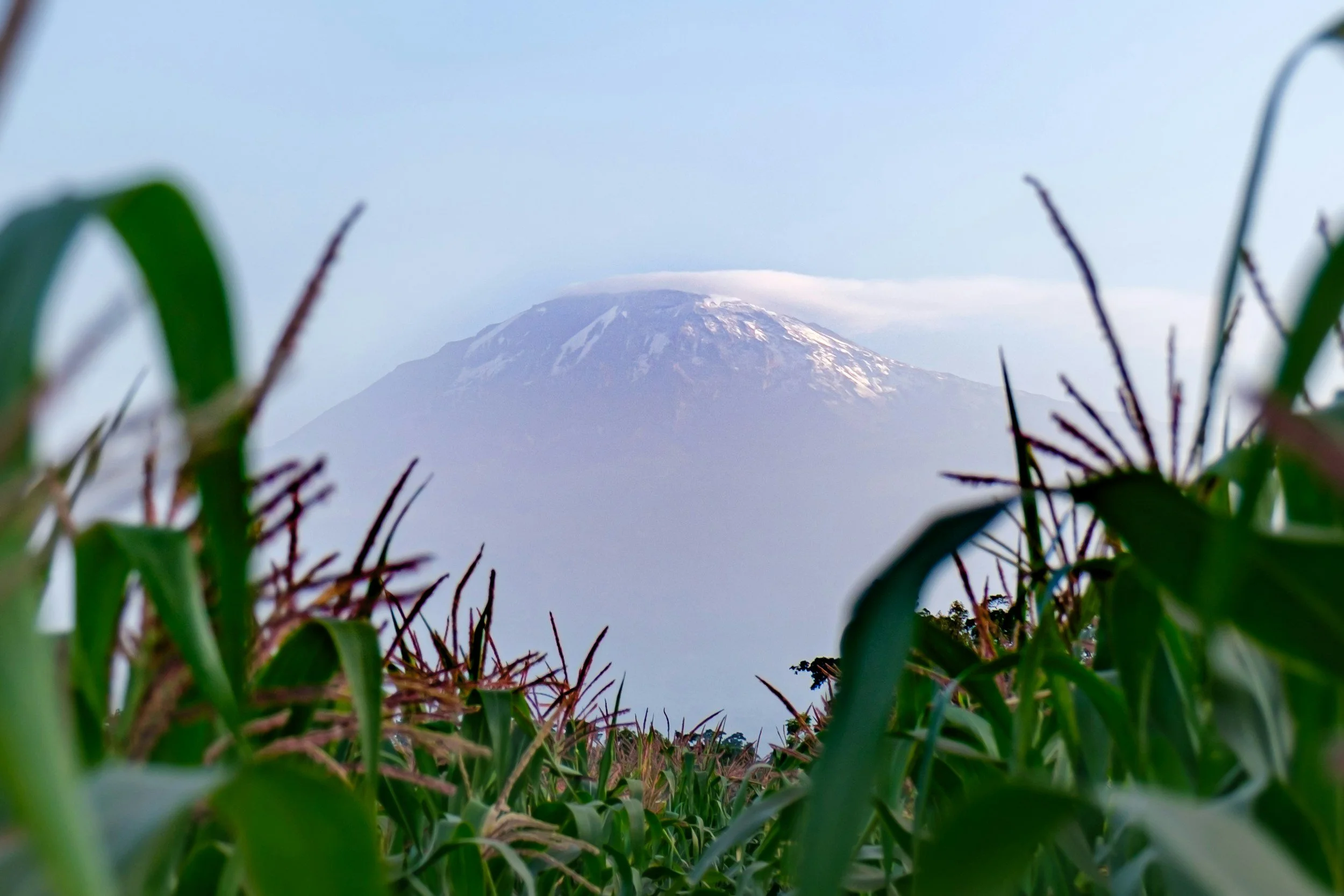
from the fertile grounds around Moshi the peak of Kilimanjaro can already bee seen clearly
We started the trek at an altitude of almost 2,000 meters and pass through different vegetative zones: coniferous forest, tropical rainforest, and open plains. A slow pace (pole pole) is deliberately maintained to gradually get used to the altitude step by step. In the late afternoon, we arrive each time at the tent camp, which has miraculously already been fully set up by the porters. In addition to the group of 15 people, there is a crew of 58 porters and helpers who carry luggage, food, and tents up the mountain. Miraculously, because they do this at a pace that terrifies us, carrying 10-15 kg on their heads. After arrival, we dive into our tent and are given a basin of hot water to wash the dust off our faces. Not long after, dinner awaits, served in a large mess tent.
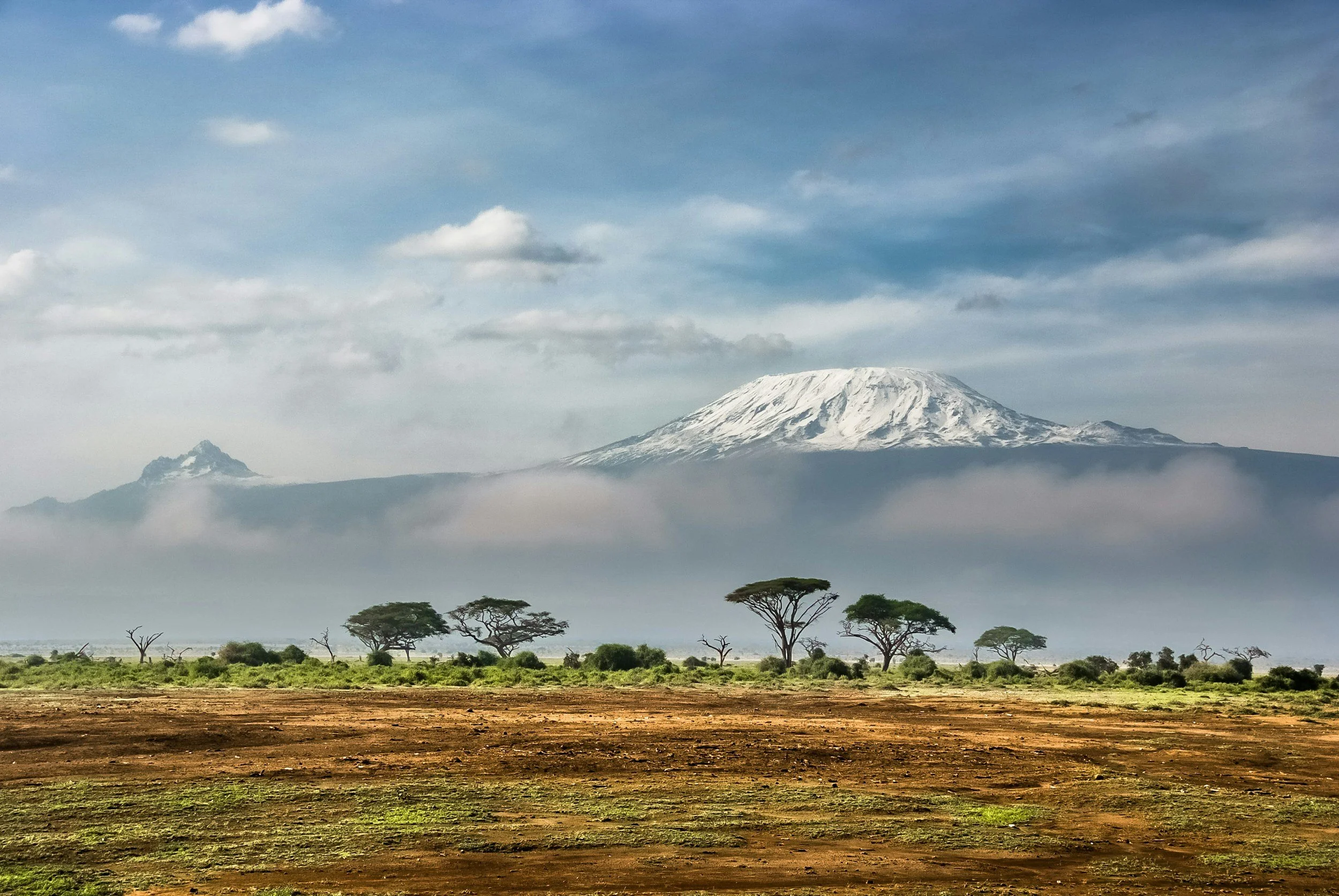
from the savannah
Usually, this is the most enjoyable part of the day. We get to know each other better, and the shared mission creates a bond. Not unimportantly, the food—given the circumstances—is excellent. Despite the camping presentation, it is fresh, healthy, and flavorful. Lots of vegetables and fruit, and even the vegetarian and gluten-free customer in our group is accommodated. We assume that anything left over is later eaten by the crew themselves.
Typically, most of us call it a night after around 7:00 p.m. and dive back into the tent. However, not before a last visit to the set-up toilet tent and a glance at the incredibly pitch-black African sky full of stars and celestial bodies. Ideally, we sleep a bit lower than the highest point we reached that day, for example, through an additional 'acclimatization walk.' As we gain altitude, the nights get colder; you really have to bundle up well to keep it somewhat comfortable. We hardly get any real good sleep; the hard ground and nighttime toilet visits are the main reasons. The prospect of having to leave the tent at night becomes too much for Darren—on his honeymoon with Robyn—and us, and soon we are laughing broadly at our 'pee bottle' solution. Camping does have something special, and the fresh air, silence, and early sleep ensure that most of us can get up reasonably fit again. Undoubtedly helped by a warm cup of tea brought to the tent at 6 a.m. Followed by a basin of hot water, and soon we can laugh and eat at breakfast again. We pack our things, take our day packs, and are often on our way around 8:30 a.m. We walk for about 6-7 hours with many breaks in between, mainly to keep drinking enough water. On most days, the sun has free rein, and lots of water also helps against altitude sickness. At each camp, the water has its own flavor; it is collected locally, boiled, and filtered.
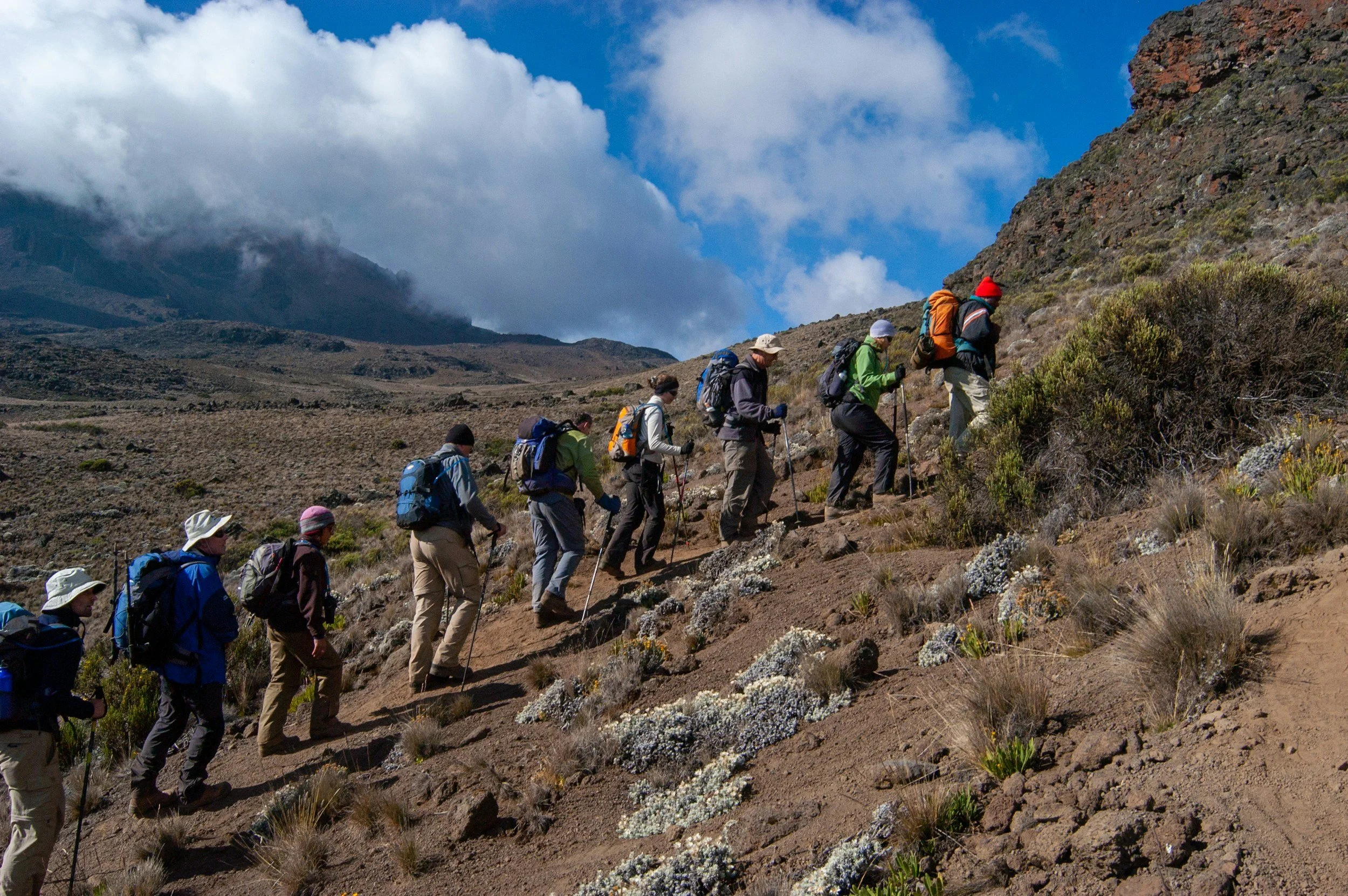
single file, the early stages
The Mawenzi camp where we have arrived is at 4,300 meters altitude; most of us are not really experiencing problems yet. Meru was 4,500 meters, and we still feel fine. In the evening at the table, we all know that what is coming will be very tough, partly because two days are combined into one very big one. It also feels a bit like a 'last supper.' The sun provides us with welcome warmth in the morning, and we set course for Kibo; the base camp for the final ascent of Kilimanjaro. It is about five hours of walking where we cover some 400 meters of elevation and are treated to a new environment: 'alpine desert.' A barren, open plain where little grows and the wind has free rein. The section is also known as the 'saddle area' between the Mawenzi and Kibo peaks, a flat intervening 'saddle' area where we constantly have our final destination in sight. In the middle of the route, something glistens next to the path, and as we get closer, it turns out to be the wreckage of a small plane, crashed in 2008 during bad weather. All occupants perished; the wreckage was never cleared. It feels a bit like the white carcasses you encounter on safari in the savannah: silent victims of a ruthless environment.
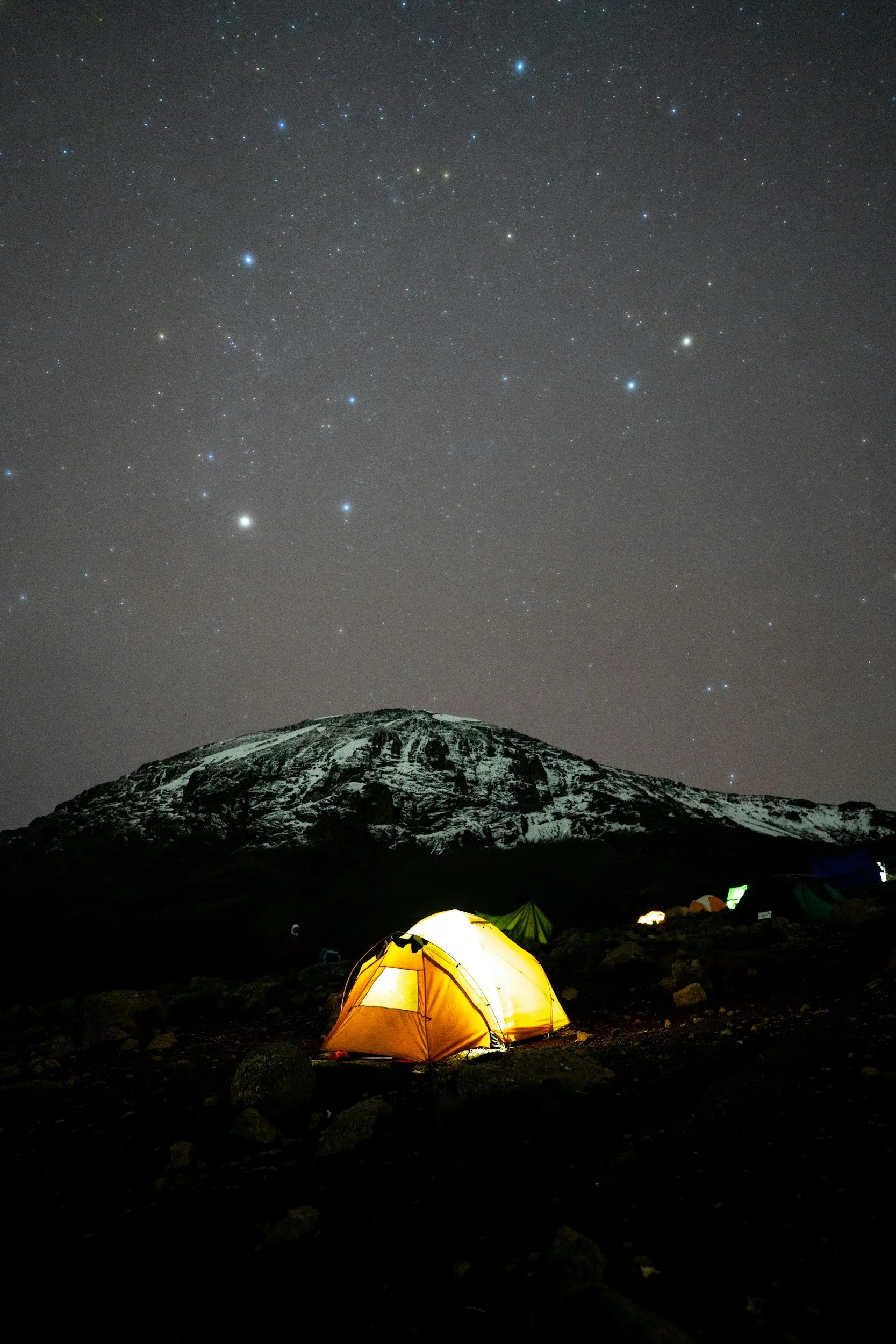
get used to staying in a tent - and starry nights
As we slowly climb to 4,700 meters in the last hour, we start to feel somewhat weakened and notice the thin air for the first time. The sun takes us mercilessly; fortunately, we know that at this altitude, we must protect and sunscreen ourselves as much as possible. Literally five minutes before arrival, someone is rushed down on a wheeled stretcher—not good timing and another sign of the tough night to follow. The group of 15 has broken into two or three pieces more often in the previous days; today, the difference grows to about 25 minutes.
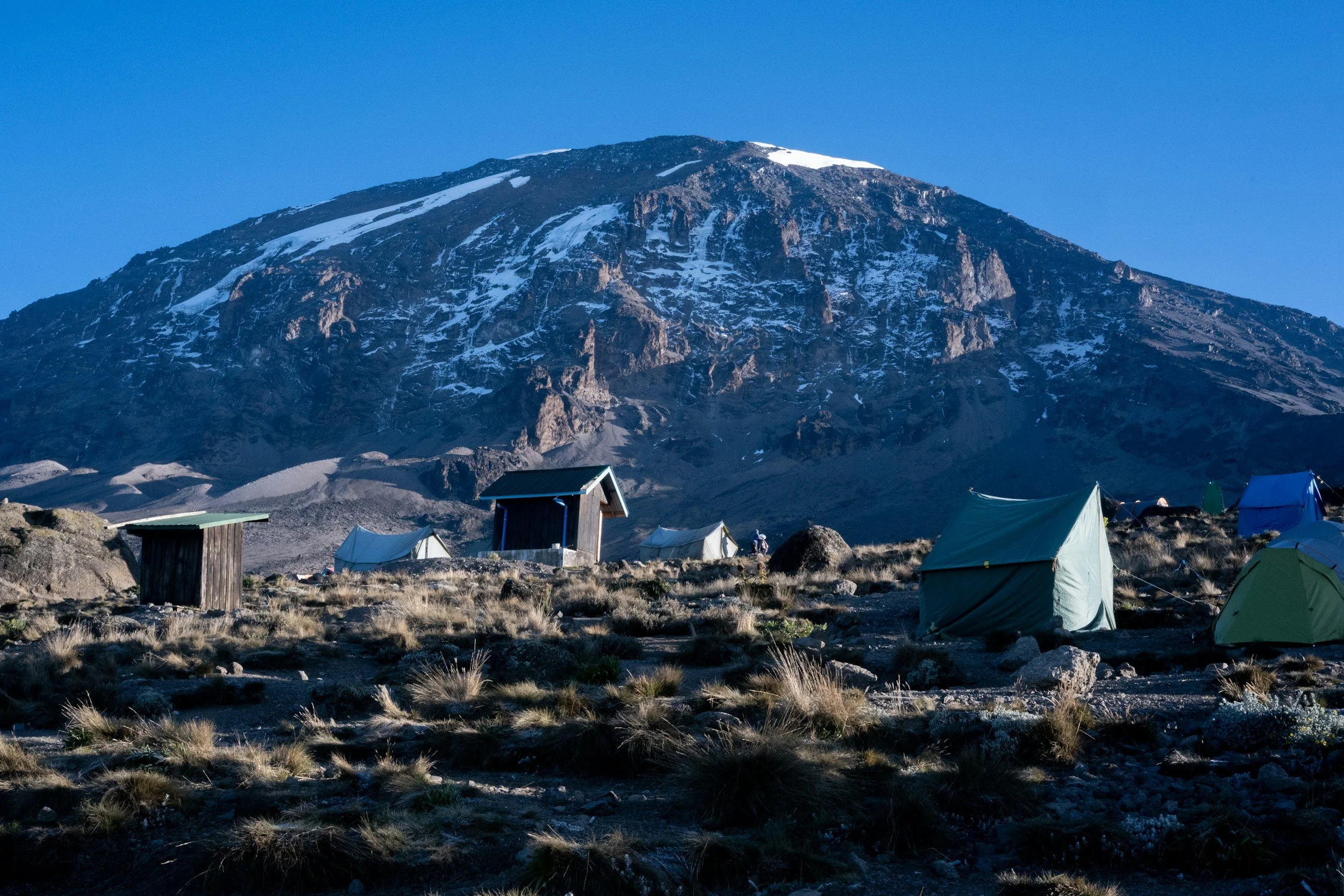
last camp before the summit attempts
The idea is that we will attempt the final ascent to the summit that same evening! 1,200 meters of elevation in 7 hours, the descent, brunch, and then another three-hour descent. It seems almost madness, and maybe it is. The reason for the nighttime ascent is twofold: experiencing the sunrise at the summit and not being able to see the endless path to the top. Especially the latter is mentally understandable, although groups with headlamps ahead of us somewhat mimic this effect. Moreover, I have to admit that such a long ascent in full sun is not really desirable either.
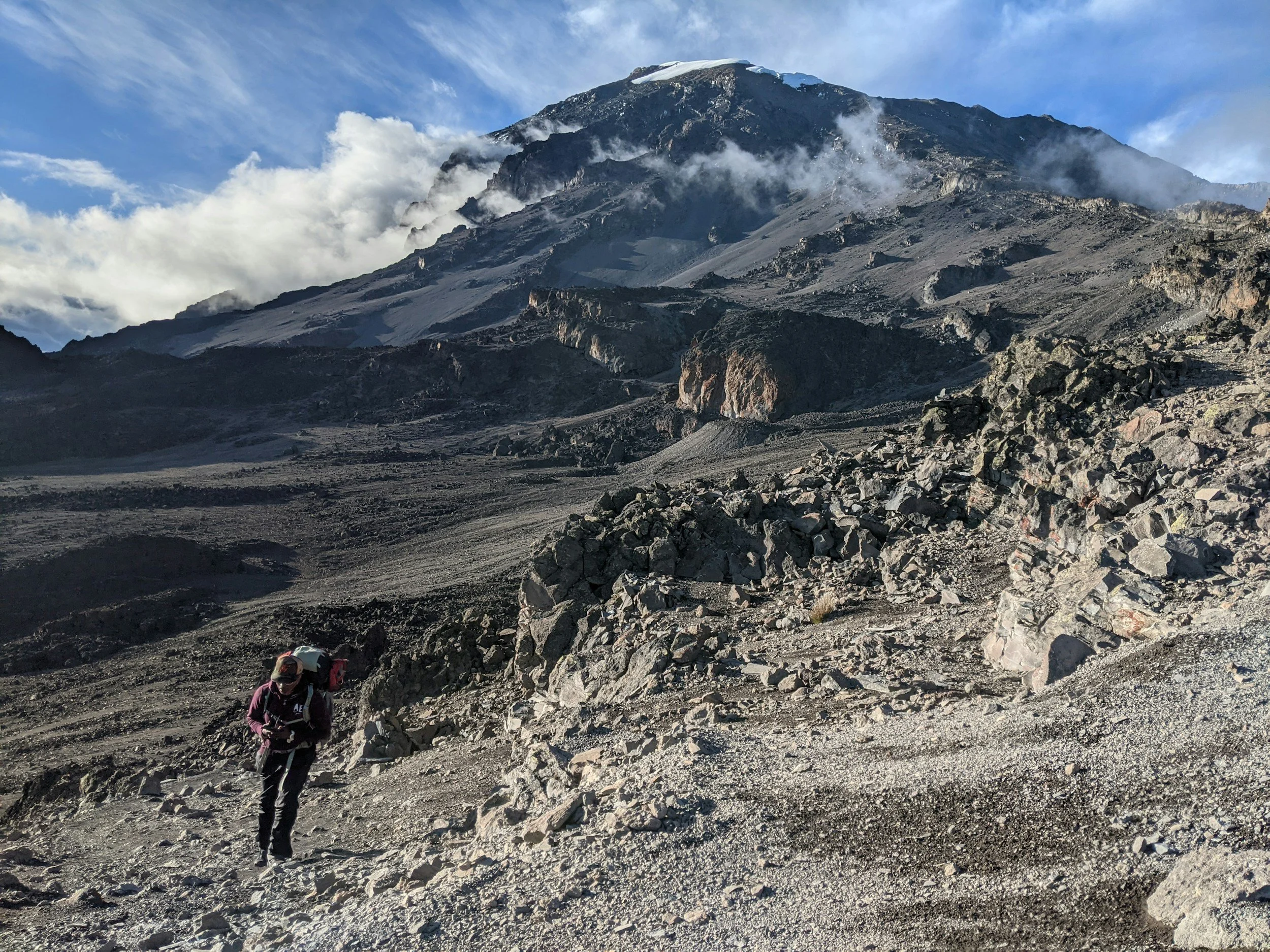
the saddle area
We force down the necessary vitamins and carbohydrates, after which a fairly dramatic 'summit briefing' follows. Symptoms that should not lead to immediate surrender include vomiting up to three times, headache, dizziness, and nausea. If you are no longer responsive, babble incoherently, or faint, you are immediately taken off the mountain. The faces of some ladies darken, and we are at least well warned. No one really gets a good three hours of sleep afterward. At 11:00 p.m. (!), we are woken up, after which we dress like Michelin men: three layers on the legs, two pairs of socks, two kinds of hats, thick gloves, and 4-6 upper layers. Ideally, thermal clothing underneath because cotton can be merciless when sweating in these low temperatures. The tricky part is that adding layers later if it's cold is difficult, and during the descent in the sun, layers must be removed. We eat some snacks in the tent, and fortunately, we can still make some jokes. It takes a while before a group of 15 is ready, especially when the American family, who has prepared everything to the last detail, still needs to be equipped with oxygen masks and tanks. Presumably, these systems give about 20% more chance of reaching the summit. If you consider that at the summit there is 50% less oxygen in the air compared to sea level, this can make the difference.
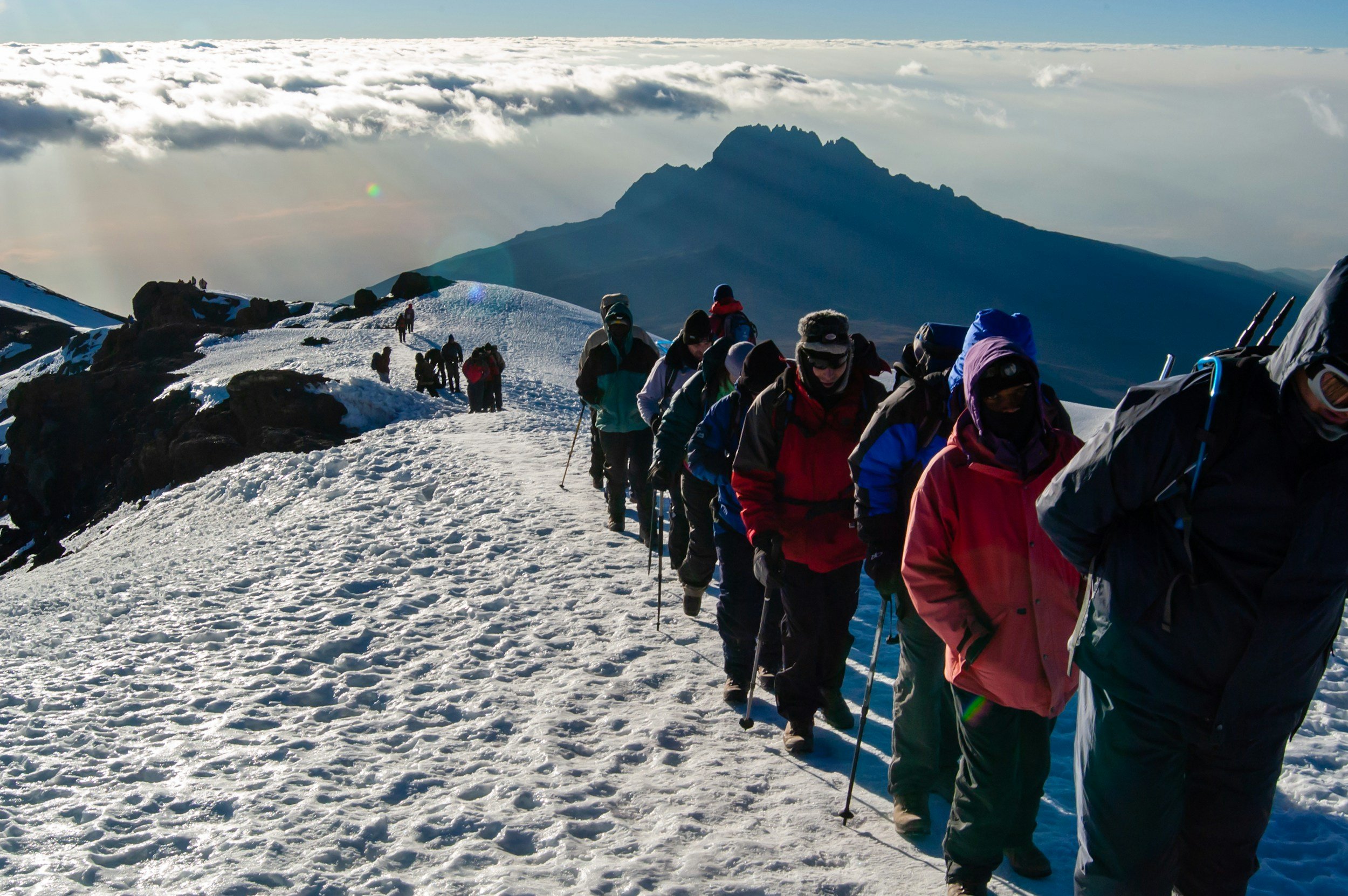
higher and higher means colder and colder
At 12:30 a.m., we finally set off, in a long line at a speed of about 2 km/h. Ahead of us, various groups that left earlier are visible via headlamps. Not even an hour has passed before we see the first unfortunates coming down, on their own strength with a helper but probably exhausted or suffering too much from altitude sickness. We zigzag up the mountain in a long line on a narrow path. It feels a bit like a cycling peloton in the queen stage. Soon, the first cracks appear in the peloton, and if you're at the back, you're chasing facts. We stop briefly every half hour to drink something. You want to keep moving because especially your toes are on the verge of freezing. It is terribly cold on the mountain.
We feel good, and as far as we're concerned, the pace could be increased a bit. Although we know from Meru that this is treacherous; at this altitude, it can come back like a boomerang. We are also venturing into unknown territory out of the comfort zone; we haven't been at this altitude before, and with every step, we try to listen to the body for signals. Maybe it feels like a diver who hasn't been at this depth before. We drank our first bottle of water perhaps a bit too quickly; when we take the second from the bag after two hours, it turns out to be almost entirely frozen. Most have placed at least one bottle upside down as recommended so that the drinking end freezes last. Because eight helpers are carrying the bags of those with an oxygen system, there is probably less capacity to bring extra water.
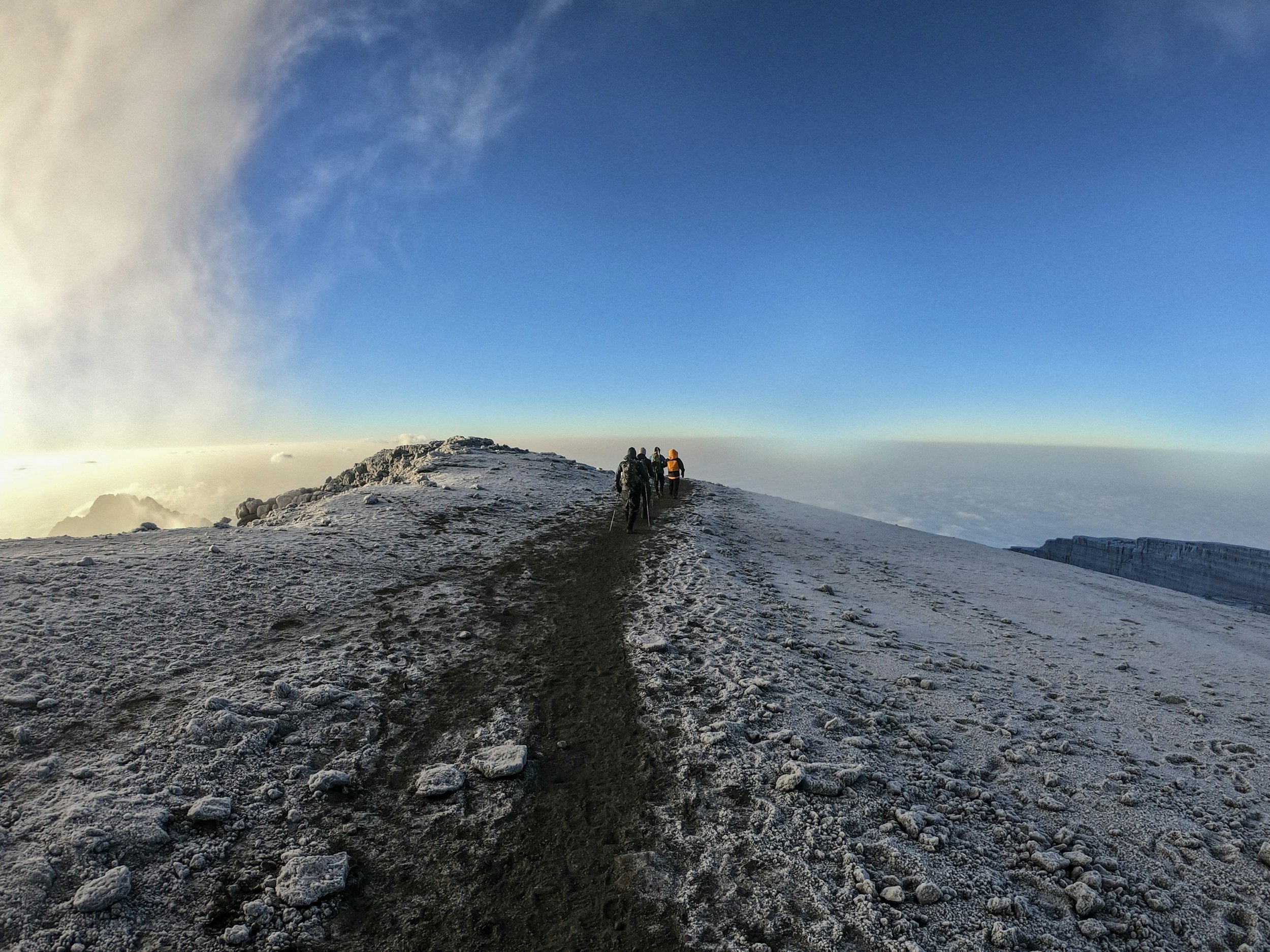
getting close to the summit
At an altitude of 5,200 meters, we start to get into trouble. The heart rate rises quickly to about 140 beats. With nose and mouth, we have to draw the maximum amount of oxygen from the air each time. Moreover, a throbbing headache sets in, and we get slightly dizzy. The headache persists, and during the break, we take a paracetamol. Intake of sugars makes you feel a bit better temporarily. Now it's a matter of survival and hoping that the summit comes within reach somehow. A few times, the thought creeps up that we won't make it. The stomach doesn't feel entirely great, and soon we have to leave a big message somewhere—right now, and it costs us most of the five-minute break. However, we are still in the lead group with three members of the American family equipped with extra oxygen, Katie from London, and Matt from Texas. Tough, steep rocky sections and gravel follow where you slide back down a bit each time. Then we hear that it's about another hour to Gilman's Point, an important intermediate station at 5,700 meters. It is now 5:00 a.m. During the short breaks, everyone drops to the ground to rest. There has been hardly any talking for a long time. The helpers try to encourage us from time to time. We have been dangling at the back of the group for a while with one helper behind us. We often have to stop briefly to catch our breath; the gap that forms is at most a few meters wide. Especially Katie seems the freshest and can still talk reasonably normally. Then we see and feel that Gilman's Point is not far away, and a small ray of light appears on the horizon. Even though it is terribly cold and windy on this protruding rock, Gilman's Point is a mental victory. Everyone knows that then 'only' 200 meters of elevation remain to be bridged. We stop for 10 minutes for snacks and hot tea that the helpers had brought.
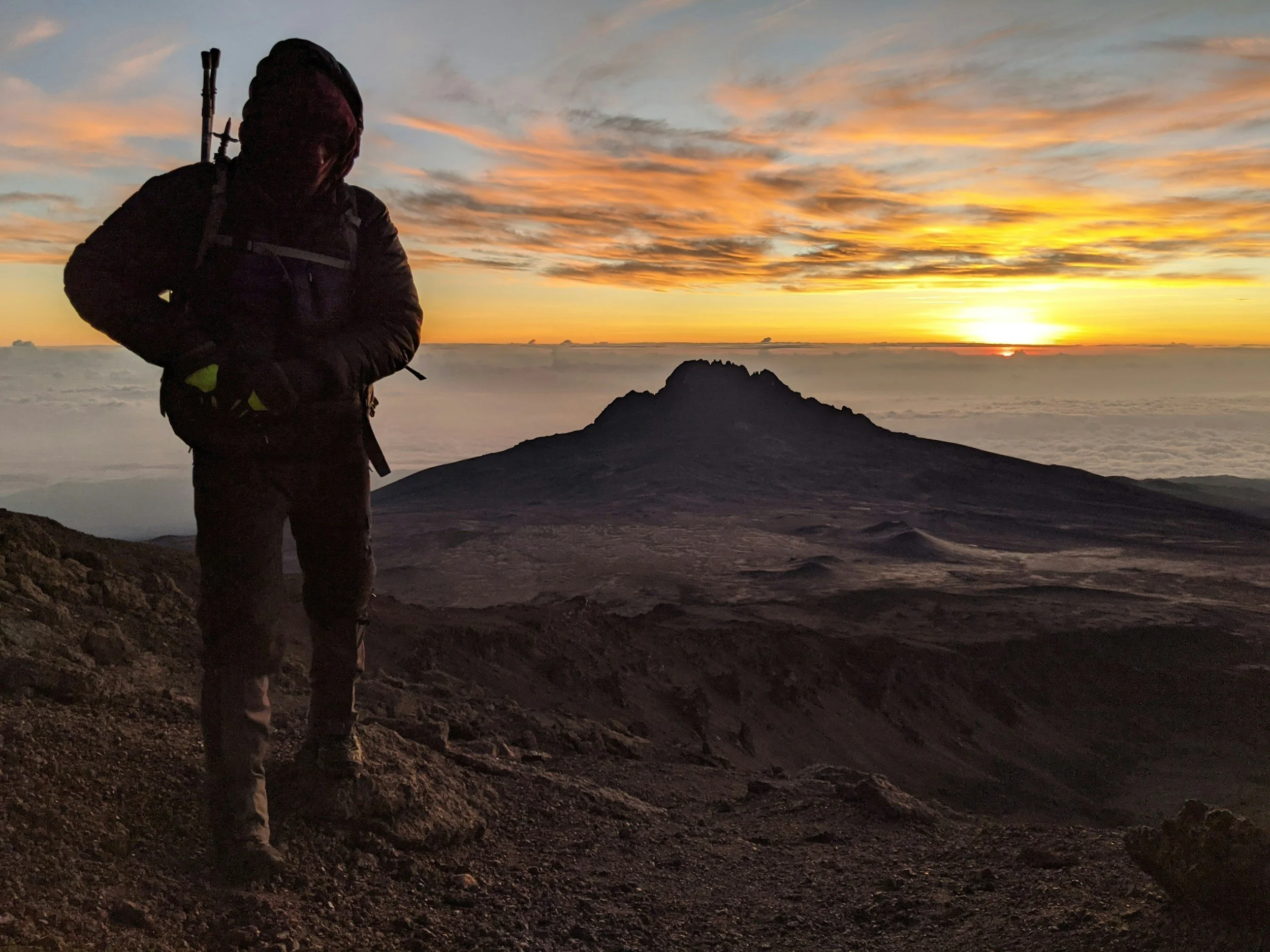
sunrise
The sun slowly rises, and amazingly, we can turn off our lights. What a boost; the sun gives us new necessary energy. The view is mighty, not only the horizon but also the crater and glaciers on the mountain. It is still about 1.5 hours of walking to Uhuru Peak on a gently ascending path. We even walk at the front for a while, although we quickly notice that we are deep into our reserves. We arrive at Stella Point where we see another route merging. We see several dozen people stumbling upward, and some fall into each other's arms crying. Some just can't go on and stare blankly ahead, pushed forward by a helper. We also see the first people returning from the summit, at least this is unmistakably readable from their faces. It is now fully light, and the route to Uhuru Peak is quite visible. Our group passes most other people on the way, although we walk the last part at the back, stopping occasionally. The glaciers that look like patches of snow from a great distance turn out to be 20-meter-high ice chunks that inspire nothing but awe.
We all know now that the summit is within reach. Just hold on a little longer. The familiar sign, the finish, looms in the distance. We give each other a high-five and collapse. Not for very long because it's crowded to line up for a photo at the sign. We take time for some food and still have a little water left. It even gets a bit warmer with the full morning sun in our faces. Relief, emptiness, but also confusion is the dominant feeling. We decide to turn around and descend the mountain, a process that normally goes at least twice as fast as the ascent. Then suddenly, as loose clumps, some from our group trickle in! Not in the order we expected beforehand. There is cheering, and we discuss how it went for the others. It quickly becomes clear that some were brought back to camp after just a few hours. We walk quickly onward; now that the goal is achieved, we long for a moment of relaxation. We quickly get warm and still have a very high heart rate. Back at Gilman's Point, we let the group go ahead a bit and drink and eat some more. We feel a bit better then. After some rocky sections, you suddenly have a complete view of the entire ascent and the base camp at the foot of the mountain. We climbed this section of almost 1,000 meters of elevation mostly zigzagging through gravel and stones. However, going straight down seems feasible for the descent. After a short stop, we rush down to get to camp quickly with the last strength. Sliding and jumping through the gravel, avoiding some stones, we are down in 25 minutes. Completely exhausted and sweaty, we arrive at the tent with the first thought 'we are really never doing this again.'
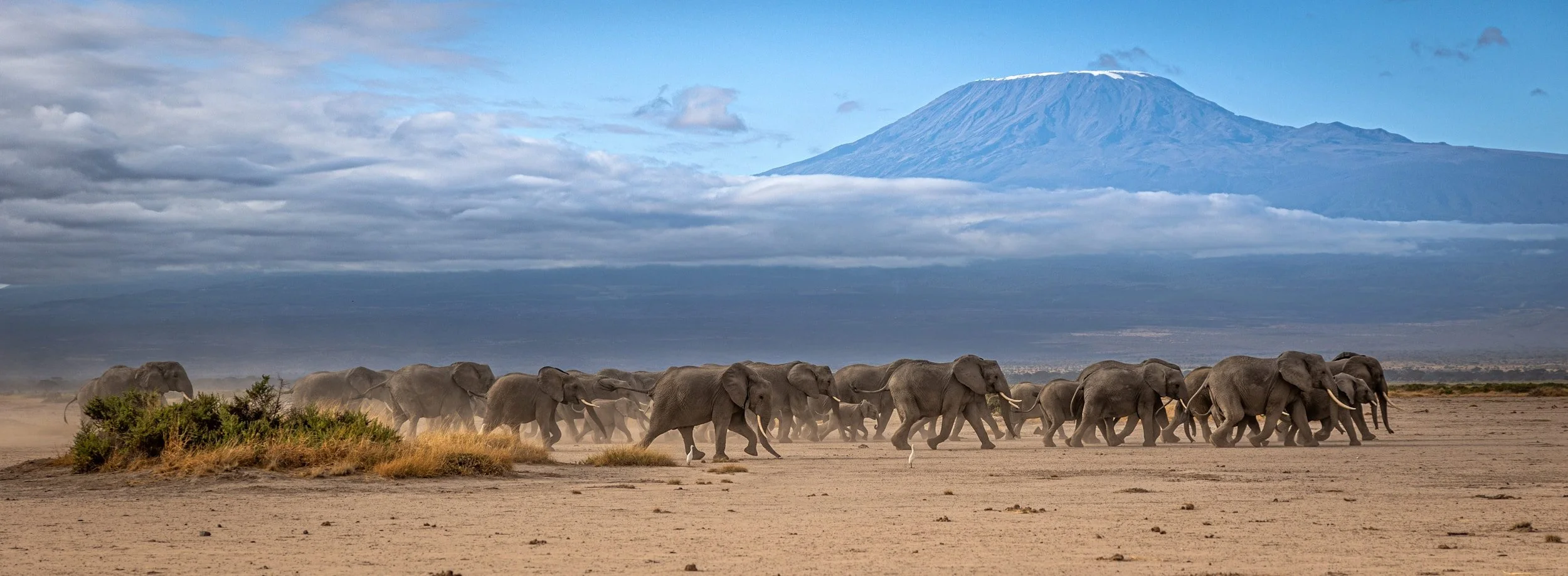
we say goodbye to the mountain
After resting a bit, the others from the group arrive. Everyone rests in the tent; real sleep doesn't happen, it's 9 a.m., and the sun shines fully into the tent. Over the past five days, a nice group feeling has developed; everyone helps and respects each other. At brunch, everyone's experiences are exchanged, and it quickly becomes clear that it has become a true battle of attrition. Four out of 15 didn't make it. Everyone seems relieved, and most are happy that the summit was reached. Especially the Americans think it's great that 'Walter' sprinted down the mountain and left only a dust cloud behind. After the meal, we pack our things and prepare for a three-hour descent to 3,700 meters. Once warmed up, we can't stop talking to each other, already savoring the thought that a shower and real bed await tomorrow. Smoothly, we arrive at the wet camp, in the middle of a misty fog. Exhausted but also proud, we get a good night's sleep. The evening before, we had already discussed all contributing $150 per person as a tip for the 50+ helpers to divide. In the morning, this is presented to them during the 'closing ceremony.' The group thanks us with song and dance. Some of us owe a huge debt of gratitude to certain helpers and also give clothing items.
That morning, a substantial descent of over five hours still awaits, and everyone pushes through the aches. Again, we talk incessantly about the most diverse topics from American politics to work and other travels. We cross through the clouds and tropical rainforest to finally return to the gate. Empty and confused. We let ourselves be guided through some formalities to take the bus back to the hotel. The shower, the terrace, and fresh salad feel paradisiacal. After a few hours, most of us find each other with a beer on the terrace, and the atmosphere is completely exuberant. For hours, there is laughter, and a surprisingly large amount of energy is released.