Year of the Horse: View from China, August & September 2026
Coffee delivered to your hotel room is the most ordinary thing in the world here—arranged through one of the "superapps" that bundle chat, payments, transportation, and food and coffee delivery into a single platform (we'll leave the privacy and competition concerns to the watchdogs). It arrives within fifteen minutes, along with a photo of exactly where it was left, since the delivery rider has to keep moving. In larger hotels, robots handle the delivery to your door. So much has changed since 2007 and 2012. Back then, coffee was almost impossible to find, let alone anything of quality—your only options were KFC or McDonald's. Now the Chinese have embraced coffee, often with an exotic twist or mixed with tea. The homegrown chain Luckin Coffee overtook Starbucks after just two years and now has more than 30,000 locations nationwide. Cash, meanwhile, is effectively extinct: refusing it is technically illegal, yet after several weeks I hadn't seen a single banknote. QR codes are everywhere instead, linked to a credit card, enabling lightning-fast payments.
Hotels and restrooms have come a long way too. It used to be that you'd hold your nose in a public bathroom; now Japanese high-tech toilets are standard almost everywhere. What I'd forgotten is how hard it is to find a quiet spot—usually the only place is your hotel room, once the door is closed. Even small cities feel crowded. Hotels are perfectly fine and affordable, if a little charmless; coziness just means something different here. The Chinese are loud, but with most vehicles now electric, the streets themselves have gone quiet. Sleek electric cars are everywhere, and ordering a ride is cheap and effortless—drivers don't even need to watch the traffic lights, since the countdown is built right into their phone app.
It's remarkable how far China has leapt technologically in the past decade, while Europe lags behind in almost every area. That's not only down to government subsidies and "unfair competition," as it's often framed in the media—the single market here is far less fragmented, energy costs three to four times less, and lighter regulation lets things move faster. It's also true, though, that the currency is kept deliberately weak to keep exports flowing.
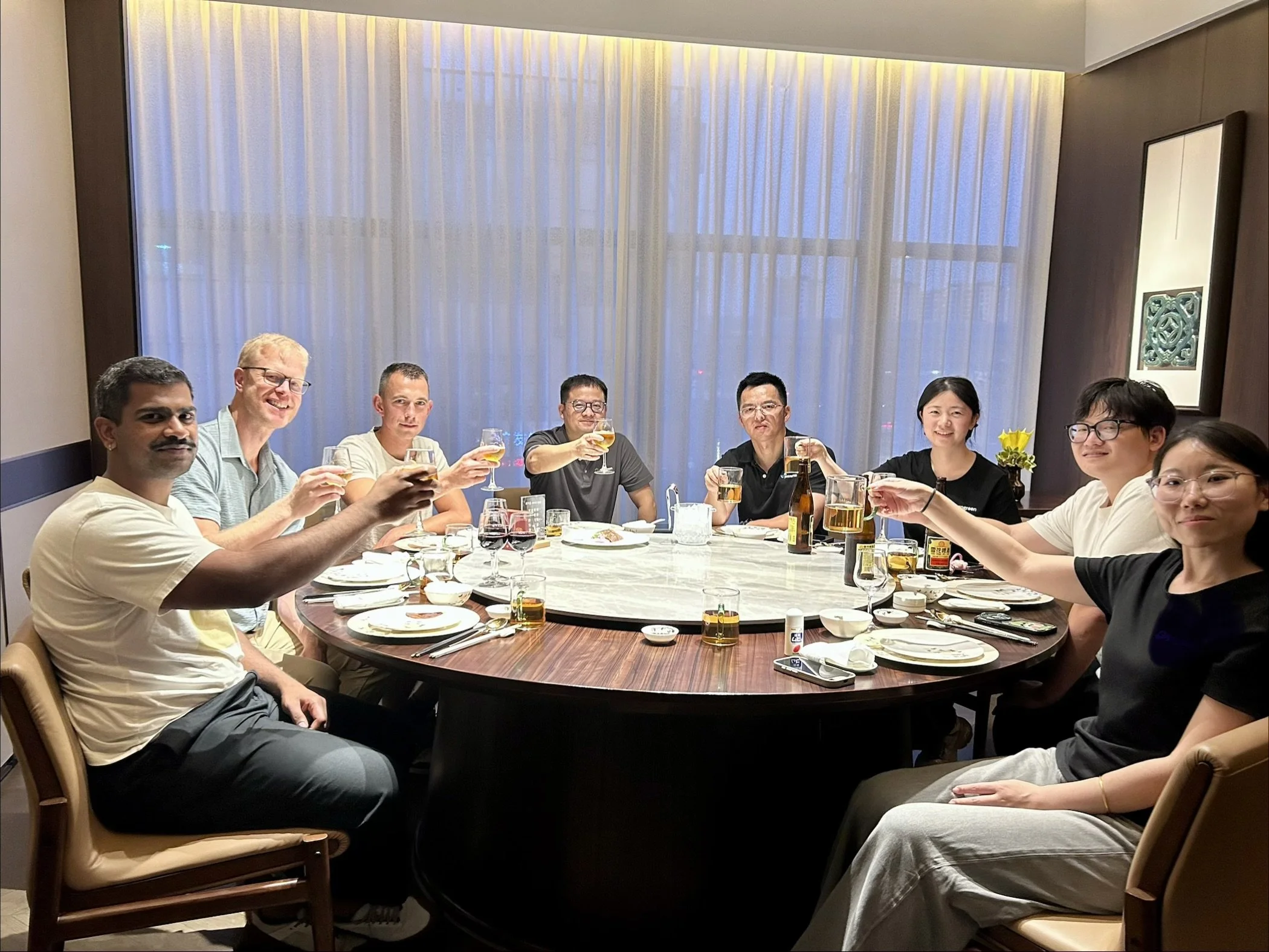
We wrap up a long day in the hotel lobby with tanghulu, candied fruit on sticks. The meeting that afternoon had started tensely—people seemed nervous, and Europeans are still held on something of a pedestal here. But once we saw the factory and the machine running live, everything changed. It was convincing, the pieces fell into place, and the mood turned warm almost instantly; a real chemistry formed. The dinner afterward was lavish—meat, fish, and wine in abundance—and back at the hotel, each of us was given a beautiful box of tea. The days that followed were a different story: finding our own way to unfamiliar factories, being shown around bleak industrial halls. In many of these industrial cities there's little to do, and you're lucky to find a decent hotel or restaurant. Translation apps make life much easier, since English is rarely spoken and in many places a Westerner is still a novelty—apparently a photo with one does well on the local version of Instagram.
While foreign tourists gravitate toward Beijing and Shanghai, Yunnan Province is by far the favorite domestic getaway for Chinese travelers. It's laid-back, mild in climate, and beautiful—renowned for its coffee, tea, mushrooms, and biodiversity. In many restaurants you won't even be handed chopsticks until the mushrooms are thoroughly cooked; food poisoning cases still crop up every year regardless. The food itself is excellent—far less processed than in Europe, and served within minutes of ordering. Meat is everywhere, but tofu and vegetables hold their own on most menus, and there are even a handful of vegan restaurants, which makes sense given Buddhism's influence.
Shangri-La turns out to be a real letdown. The thin air at 3,300 meters is pleasant enough, but the town itself doesn't deliver—Tibetan monasteries and culture are visible, yet even the surrounding landscape lacks the towering peaks you'd expect. I start to suspect that the mythical Shangri-La, the gateway to Tibet immortalized in the 1933 novel Lost Horizon, simply isn't here. So I catch a bus deeper into cultural Tibet. Four hours of winding mountain roads bring breathtaking views; the language changes, the people are more sun-worn, but it's still noisy and short on atmosphere. At 3,300 meters everything takes a bit more effort, even with the now-standard extra oxygen supply piped into hotel rooms. I push another hour further into the valley, to a small village on the border of official Tibet. Finally, quiet—if no coffee delivery.
This village is the trailhead for a hike into the high mountains, and as always, the mountain vibe is wonderful. People greet each other and actually stop to talk. A handful of other hikers are staying at the hostel, and it brings back memories of the old backpacker trails crisscrossing Asia. From what's nicknamed "the Chamonix of China," there's a stunning view of glaciers on Himalayan giants over 6,000 meters high—though the village itself is thoroughly commercialized, one vast construction site for dozens of new hotels. On the way back down, a fast-moving Basque hiker catches up with me. Basques are serious mountaineers and cyclists, and while I'm usually not the slowest, I can barely hold his pace for an hour before letting him go ahead. We're the same age; he's been coming to the Himalayas for twenty years for the big climbs through snow and ice.
After the picturesque, easygoing Lijiang comes Chongqing—"China’s frying pan." It's September, but the temperature is still pushing 40 degrees. This is the birthplace of Sichuan hot pot, today home to 30 million inhabitants. The former WWII-era capital grew wealthy from trade, sitting at the confluence of two mighty rivers, and today it's a sizzling, futuristic metropolis—less familiar to Western audiences, but more affordable than Beijing or Shanghai. Shopping malls stretch on endlessly, open seven days a week until around 10 p.m. Yet despite all the progress, youth unemployment runs high and competition for good jobs is fierce. Outside AI, data, and the big tech firms, wages stay low and work is hard to come by; many take on side jobs as food-delivery riders or taxi drivers. Young men in particular have to work hard and head for the big cities just to compete in the marriage market.
There are 35 million more men than women in China, and it shows who holds the leverage. A groom's family is expected to provide a dowry—an apartment and a car—and the intense culture of saving acts as a natural brake on spending. A wedding, on the other hand, is something of a business model: guests are expected to slip at least a month's salary into an envelope, and every gift is meticulously logged in a spreadsheet so accounts can be settled at the next wedding down the line.
Back in late 2014, a colleague and I spent two weeks touring factories across China and Taiwan. It was his first visit, and he could barely believe the scale of construction underway in every city—who was all this for, and who was paying for it? In hindsight, he was right to be skeptical: it was a bubble. A new, unregulated form of capitalism was inflating the market, construction kept going fueled by mounting debt, and homes were sold before they were even built. Tragically, real estate was the only market where ordinary Chinese savers could invest, so building shifted from housing people to feeding speculation. When the bubble finally burst, billions in savings evaporated. The country's largest contractor collapsed, and its founder is now serving a life sentence.